Best Lightweight Golf Bags for Older Golfers Who Walk

A heavy golf bag does not ruin a round all at once.
It does it quietly.
A little more effort getting it out of the car. A little more strain walking uphill. A bit more rummaging when the towel or glove has disappeared into the wrong pocket.
By the back nine, those small things can start to matter.
That is why the best lightweight golf bag is not necessarily the lightest one on the market or the one with the most pockets.
It is the one that suits the way you play now.
Light enough to make walking easier. Useful enough to carry what you genuinely need. Comfortable enough that you are not adjusting it all day.
If your current bag still works well, keep it.
But if it feels heavier than it should or makes the last few holes harder work, there are some sensible lighter options worth considering.
The right bag should make the walk easier, not give you more to manage.
Before you start shopping
This guide is mainly for golfers who still enjoy walking but want to take a little unnecessary effort out of the round.
Some of the bags below are made for carrying. One is better suited to a trolley.
That distinction matters.
A very light carry bag is no use if you normally push or use an electric trolley. Equally, a large trolley bag may be more storage than you need if you still carry most weeks.
So start with the way you actually get round the course.
Affiliate Disclosure
Some links in this article are affiliate links. If you buy through them, I may earn a small commission at no extra cost to you. Thank you for supporting Every Round Golf.
My lightweight golf bag picks
I would keep the shortlist simple.
Best for golfers who still carry regularly: Titleist Players S4
The current Titleist Players S4 weighs about 2.4kg and has a premium double strap, eight pockets and a four-way top. It is not the lightest stand bag here, but it is designed to balance comfort, storage and stability rather than chase the lowest possible number on the scales. Titleist
Who it suits: golfers who still carry most weeks and want a proper stand bag with enough storage for a normal round.
Why I like it: the updated double strap is designed to spread the load more evenly, while the eight-pocket layout gives you useful storage without turning the bag into something oversized.
What to bear in mind: at around 2.4kg, it is noticeably heavier than the Players 4 Carbon. If your main aim is simply to carry the least weight possible, the Carbon is the better fit.
Best if low weight matters most: Titleist Players 4 Carbon
If you still like carrying but want to strip the weight back further, the Players 4 Carbon is worth a look.
The current model is listed at around 1.4kg, with six pockets, a double strap and carbon-fibre legs. Titleist
Who it suits: golfers who genuinely value carrying as lightly as possible.
Why I like it: 1.4kg is notably light for a proper stand bag, and you still get a double strap, drink pocket and useful storage.
What to bear in mind: you pay more for that lower weight, and six pockets may feel limiting if you like to carry plenty of clothing and extras.
This is the sort of bag I would consider if your main complaint is simply that your existing carry bag feels heavier than it needs to.
Best for wet-weather golfers: Titleist Players S4 StaDry
If you play regularly through a British autumn and winter, weight is only part of the decision.
The Players S4 StaDry uses waterproof materials and seam-sealed zips, with eight pockets, a double strap and a four-way top. Titleist lists it at around 2.5kg in the specifications, so it is heavier than the two bags above, but still designed as a carry-friendly stand bag. Titleist
Who it suits: golfers who still walk in wet weather and want to keep their gear dry without moving to a large trolley bag.
Why I like it: waterproof construction, sensible storage and a proper double strap make more sense for year-round UK golf than chasing the absolute lowest weight.
What to bear in mind: it is more expensive and heavier than the lightest carry bags.
If your current problem is wet gloves, damp clothing and a soaked scorecard rather than pure weight, this may be the more sensible direction.
Best for golfers who mainly use a trolley: Motocaddy Lite-Series
Not every older golfer who wants a lighter bag wants to carry it.
The 2026 Motocaddy Lite-Series weighs around 2.2kg and has a 14-divider top, seven pockets, an insulated food-and-drink pocket and Motocaddy's EASILOCK system for securing it to compatible trolleys. Motocaddy
Who it suits: golfers who normally use a push or electric trolley but still want a bag that is easy to lift in and out of the car.
Why I like it: it gives you the organisation of a trolley bag without becoming especially heavy.
What to bear in mind: if you still carry regularly, this is not the one I would choose.
That difference matters. A trolley bag should make trolley golf easier rather than trying to do every job.
How light does a golf bag need to be?
There is no magic number.
The manufacturer's weight is useful when comparing bags, but it only tells part of the story.
Once you have added clubs, water, waterproofs and the usual bits and pieces, balance and comfort matter just as much.
A very light bag can still feel awkward if the straps are poor or the weight sits badly.
A slightly heavier bag can sometimes feel easier to carry if it sits naturally across the shoulders.
So I would use weight as a guide rather than the entire buying decision.
Saving a few hundred grams is useful.
Saving a few hundred grams and ending up with uncomfortable straps is not.
Match the bag to the way you get round
Before looking at brands or prices, be honest about how you play.
Not how you used to play.
Not how your playing partners do it.
How you play now.
Carry bag
A carry bag suits golfers who still enjoy carrying and want to keep things simple.
If you carry, look closely at the strap system, balance and how the bag sits once it is loaded.
A bag that looks wonderfully light when empty can feel very different once clubs, water and waterproofs are inside.
Stand bag
A stand bag is a good middle ground.
It suits golfers who carry but do not want the bag lying on wet grass, and some models work reasonably well on a trolley too.
Look for stable legs, a comfortable strap and a base that does not feel awkward every time you put it down.
Trolley bag
A trolley bag makes sense if you mostly use a push or electric trolley.
Weight still matters because you have to lift it in and out of the car.
But organisation and stability on the trolley matter more than shoulder straps.
If you are also deciding whether a push or electric trolley suits you better, you may find Best Golf Trolleys for Older Golfers: Push or Electric? useful.
Too many pockets can work against you
Pockets are useful until they encourage you to carry too much.
That is how old gloves, winter hats, spare jumpers, loose tees, broken pencils and forgotten snacks end up travelling round every week.
Nobody plans it.
It just happens.
A lighter bag can help because it makes you decide what actually earns its place.
You do not need to strip the bag down to nothing.
You just need to stop carrying things that have not helped you for months.
If your bag has quietly become a storage cupboard, this may help:
Golf Bag Clutter After 60: What to Carry and What to Leave Out
Comfort matters before weight
If you carry, do not judge a bag by weight alone.
I have always found double-strap bags a little awkward to get on and off, especially when the bag is fully loaded. They can spread the weight well once they are sitting properly, but that does not mean they suit everyone. If you find yourself wrestling with the straps every time you pick the bag up, a lighter single-strap or simpler carry option may actually feel easier.

A slightly heavier bag that sits well can feel better than a lighter bag that pulls awkwardly on one side.
The straps should feel comfortable.
The bag should sit naturally.
It should not keep sliding, twisting or digging in.
And you should not feel as if you are adjusting it after every hole.
That kind of irritation becomes tiring over 18 holes.
For golfers who want to keep things very simple, Golf Gear Direct's pencil bag range is worth a look.
The things you use should be easy to reach
A good golf bag should make the useful things easy to get to.
Water.
Towel.
Glove.
Balls.
Tees.
You should not have to open three different pockets to find something you use several times a round.
In summer, water should be easy to reach.
In wet weather, the towel should be easy to reach.
Simple storage beats clever storage if it makes the round easier.
Think about wet weather too
A lightweight bag still needs to cope with the weather you actually play in.
If you regularly play through autumn and winter, water-resistant materials, covered zips and a rain hood are worth considering.
You do not necessarily need a fully waterproof bag.
But if the contents are getting damp every time the weather turns, the bag is not helping.
If wet-weather golf is becoming more of a consideration, you may also find Winter Golf Gear That Makes Cold Rounds Easier useful.
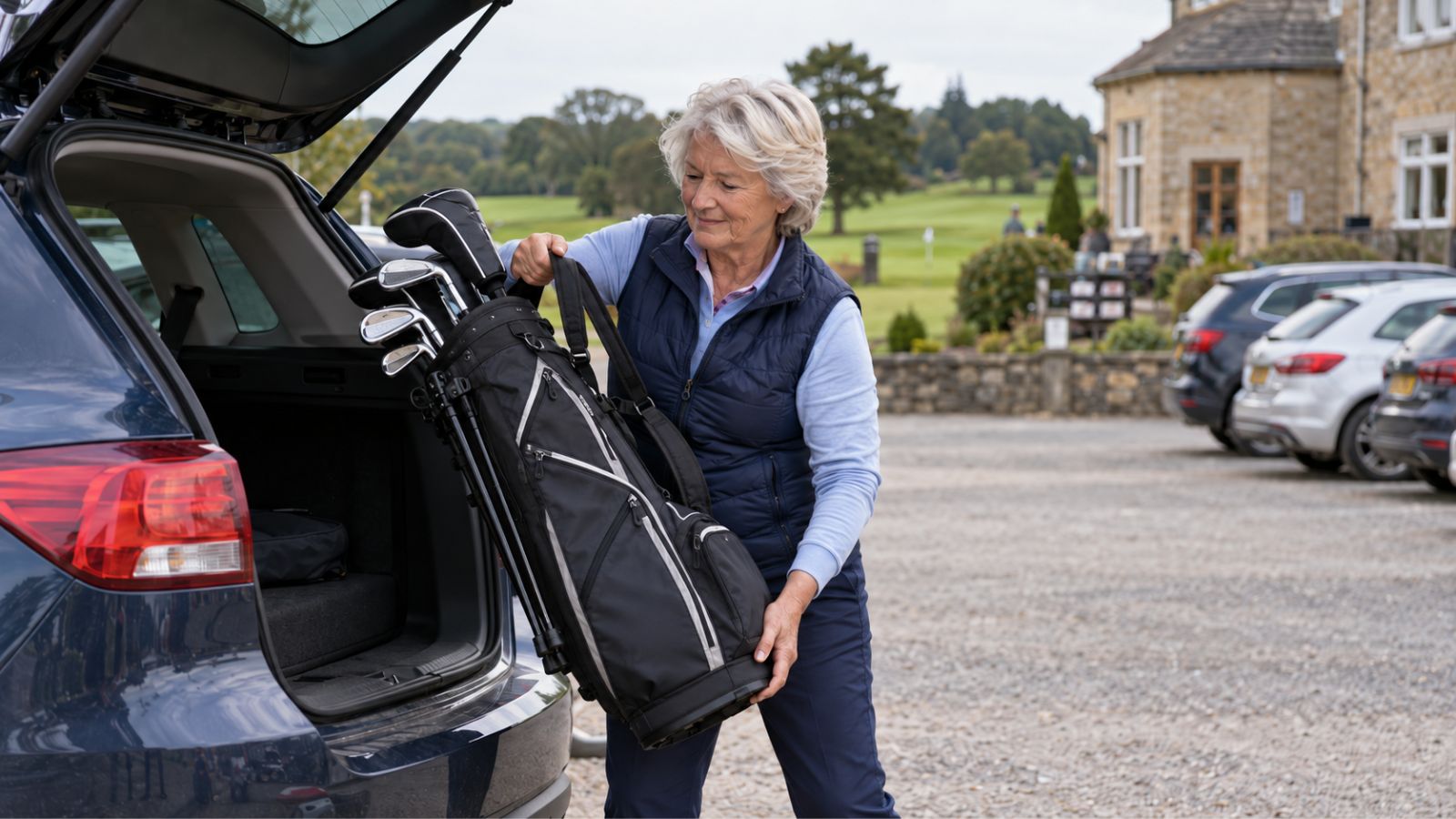
Try the car park test
A bag can look perfectly manageable in the house or pro shop.
The first proper test is often in the car park.
Can you lift it out easily?
Does it already feel awkward before you reach the first tee?
Are you carrying things simply because they have always lived in the bag?
Then notice how it feels when you put it back in the car after 18 holes.
If the bag feels like hard work at both ends of the round, that tells you something useful.
You may not need to replace it immediately.
But it is worth noticing.
When to keep the bag you already have
There is no need to buy a new bag simply because newer ones are available.
Keep your current bag if:
- it is comfortable to carry or move
- it sits well on your trolley
- you can reach what you need
- the weight feels manageable
- the pockets help rather than encourage clutter
- it is not making the round feel harder
That is the sensible answer.
This is not about buying gear for the sake of it.
If something works, keep using it.
Signs it may be time to compare options
It may be worth looking at other bags if:
- it feels heavy before the round starts
- the straps dig in or sit awkwardly
- lifting it in and out of the car has become a nuisance
- you carry too much because the bag has too much room
- you spend too much time rummaging for simple things
- you avoid carrying because the bag feels like hard work
None of those problems is dramatic.
They are simply the sort of small irritations that can make golf less enjoyable.
If you want to compare a wider range before deciding, Scottsdale Golf's golf bag range is another useful place to look.
Do not buy more bag than you need
Golf bags can be a little like suitcases.
The bigger they are, the more you find to put in them.
That may be fine if you always use a trolley and genuinely want the storage.
But if the aim is to make walking easier, more space is not always an advantage.
Ask yourself:
What do I actually use during a normal round?
For many golfers, it is not a huge list.
A few balls.
Tees.
A glove.
A towel.
Water.
A small snack.
A waterproof if the forecast calls for it.
A few personal bits.
That is enough for most rounds.
The bag does not need to become a travelling cupboard.
A final check before choosing
Before buying, ask:
- Do I carry, use a trolley, or do both?
- Is the bag easy to lift in and out of the car?
- Does it feel balanced when loaded?
- Can I reach water, towel and balls easily?
- Are there enough pockets without encouraging clutter?
- Will it cope with the conditions I normally play in?
- Is it comfortable for the way I play now?
That final question matters most.
Not the way you played twenty years ago.
The way you play now.
Final thought
A lighter golf bag will not fix your golf.
It will not make every putt drop or find the middle of every fairway.
But it can remove one small source of effort.
And over four hours, that can matter.
The right bag should feel easy to lift, simple to organise and comfortable to live with for 18 holes.
That is all good golf gear really needs to do.
If you'd like a simple golf thought to take into the weekend, my free Friday email might be worth a look.
Every Friday I share one practical thought to help make your next round a little easier or more enjoyable.
See you out there,
Andrew