Winter Golf Gear That Makes Cold Rounds Easier

Winter golf has a way of showing you which bits of gear are genuinely useful.
Cold hands, wet feet and too many bulky layers can make a round feel harder than it needs to.
You do not need a bag full of winter equipment.
You need a few things that keep you warm, dry and comfortable without getting in the way.
That is the test I would use.
Does it make a cold round easier to enjoy?
If it does, it earns its place.
Before you start shopping
Winter golf gear can get expensive quickly if you start buying a bit of everything.
I would begin with the things you notice most over 18 holes:
- keeping your upper body dry
- keeping your feet dry
- keeping your hands warm
- wearing layers you can still move in
- carrying only the extras you genuinely use
Everything else comes after that.
Affiliate Disclosure
Some links in this article are affiliate links. If you buy through them, I may earn a small commission at no extra cost to you. Thank you for supporting Every Round Golf.
A waterproof jacket is where I would start
A good waterproof jacket earns its keep quickly in Britain.
But warmth is only half the job.
You still need to play golf in it.
If a jacket feels tight across the shoulders or bulky through the arms, you will notice it every time you swing.
I would rather have something light enough to move in and add another thin layer underneath when needed.
Who it suits: golfers who play regularly through autumn and winter and want one dependable outer layer.
Why I like it: a lighter waterproof deals with wind and rain without making the upper body feel bundled up.
What to bear in mind: check whether it is genuinely waterproof rather than simply water-resistant, and make sure there is enough room underneath for a mid layer.
ProQuip Aqualite Pro Rain Waterproof Jacket from Affordable Golf
Do not buy the thickest jacket simply because it feels warmer in the shop.
You have to wear it for four hours.
Dry feet make a bigger difference than people think
You do not need heavy rain to finish a winter round with wet feet.
Morning dew can do it.
So can wet rough and soft ground.
Once the socks are damp and your feet start getting cold, the rest of the round can feel considerably longer.
That is why waterproof golf shoes are one of the first winter purchases I would get right.
Who they suit: golfers who walk regularly through autumn and winter.
Why I like them: dry feet remove one irritation that can otherwise follow you around for several hours.
What to bear in mind: waterproofing should not come at the expense of fit. A dry shoe that pinches your toes is not much help.
Puma Ignite Elevate X Spikeless Golf Shoes from HotGolf
If walking comfort is already becoming an issue, you may also find this useful:

Cold hands can change the round quickly
Cold hands affect more than comfort.
Grip changes.
Feel disappears.
Even getting a tee or ball marker out of a pocket becomes more awkward.
There are two sensible ways to deal with it.
Some golfers like proper winter golf gloves.
Others prefer their normal glove for the shot and something much warmer between shots.
Neither is right for everyone.
The better option is the one that keeps your hands warm without making the round more fiddly.
Winter gloves
Winter golf gloves make sense if you like keeping both hands covered while playing.
Who they suit: golfers whose hands get cold quickly and who do not want to keep changing gloves.
Why I like them: they give you a little more warmth while still allowing you to hold the club normally.
What to bear in mind: some feel noticeably thicker than a normal golf glove. If you dislike that extra material around the grip, mitts may suit you better.
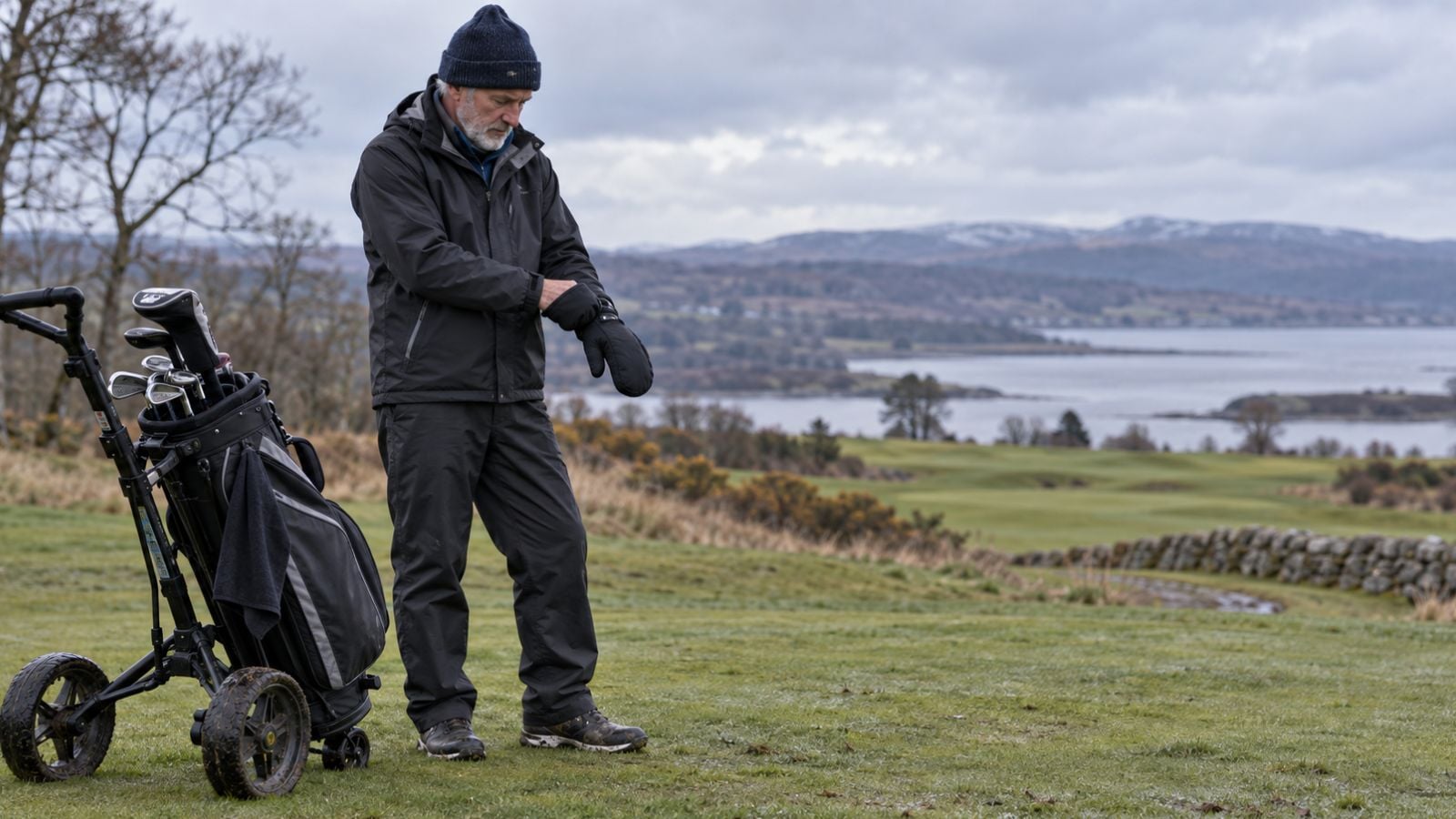
Warm mitts are often the easier option
For many golfers, mitts are simpler.
Play the shot in your normal glove.
Put the mitts back on while you walk.
That gives you warmth between shots without changing how the club feels in your hands.
Who they suit: golfers who want warm hands but prefer their usual golf glove when hitting the ball.
Why I like them: there is very little to think about. On, off, hit the shot, back on again.
What to bear in mind: choose a pair that opens wide enough to slip on easily. If they become a wrestling match every hole, they will soon stay in the bag.
Layers should help you move
Winter golf can become awkward when one layer turns into four.
A jumper goes on.
Then another.
Then the waterproof.
By the first tee, everything feels tight.
I prefer a simpler approach:
- a light base layer
- a comfortable mid layer
- a waterproof or windproof outer layer
That is enough for most cold days.
The aim is not to wear as much as possible.
It is to stay warm while still being able to turn and swing normally.
A base layer can do more than another jumper
A base layer is useful because it adds warmth without much bulk.
That can be a better option than simply putting another heavy top on.
Who it suits: golfers who feel the cold but dislike feeling wrapped up.
Why I like it: it adds warmth underneath everything else without changing how freely the arms move.
What to bear in mind: it should feel comfortable rather than restrictive. If it feels too tight before the round, it will probably annoy you later.
A few winter extras are worth carrying
You do not need a collection of winter gadgets.
A few ordinary things are enough.
A warm hat.
A dry towel.
A spare glove.
A decent pair of socks.
An umbrella when the forecast looks poor.
If you use a trolley, keeping a spare light layer somewhere dry can also be useful.
The question I would ask before adding anything else is:
Will I actually use this during the round?
If the answer is probably not, leave it at home.
A decent umbrella still earns its place
Umbrellas are not exciting.
They are useful.
On an exposed course, ten minutes of proper rain can make a good umbrella feel like money well spent.
I would look for something large enough to cover you and the bag, but not so heavy that it becomes awkward in the wind.
If your current umbrella spends more time turning inside out than keeping you dry, this may help:
Do not turn the bag into a winter cupboard
Winter bags have a habit of getting heavier.
Another glove.
Another jumper.
Extra socks.
A flask.
Two towels.
A hat you never wear.
Before long, the trolley or bag is carrying half the wardrobe.
There is nothing wrong with being prepared.
But there is a difference between prepared and overloaded.
Every extra item still has to be lifted into the car, moved around the course and put away afterwards.
Take what you are likely to use.
Leave the rest.
If your bag has slowly become a storage cupboard, this may help:
Golf Bag Clutter After 60: What to Carry and What to Leave Out
And if the bag itself is becoming hard work:
The car park tells you quite a lot
Winter golf gear often looks fine indoors.
The better test is outside.
Can you move easily once everything is on?
Can you bend down comfortably?
Can you get the waterproof jacket on without fighting with it?
Are the shoes easy to get into?
Can you still swing freely?
Those are the things you will notice on the course.
If something already feels awkward before you reach the first tee, it is unlikely to feel better by the fifteenth.
What I would prioritise first
If I were sorting out winter golf gear from scratch, I would start here:
- A waterproof jacket that still lets me move
- Waterproof golf shoes that fit properly
- Winter gloves or warm mitts
- A light base layer
- A warm hat
- A dry towel
- A reliable umbrella if the course is exposed
That covers most of what matters.
You do not need a huge winter setup.
You need enough to stop the weather becoming the main story of the round.
A simple buying rule
Before buying anything for winter golf, ask yourself:
- Will it keep me warmer?
- Will it keep me drier?
- Can I still move properly in it?
- Will I genuinely use it?
- Does it make the round easier?
If the answer is yes, it is probably worth considering.
If not, you can probably keep your money.
Final thought
Winter golf does not need to become a battle with the weather.
A decent jacket.
Dry feet.
Warm hands.
Layers you can actually move in.
That takes care of most of it.
You do not need more gear for the sake of having more gear.
You need the right few things to make a cold round easier to enjoy.
If you'd like a useful golf thought to take into the weekend, my free Friday email might be worth a look.
Every Friday I share one thought to help make your next round a little easier or more enjoyable.
See you out there,
Andrew